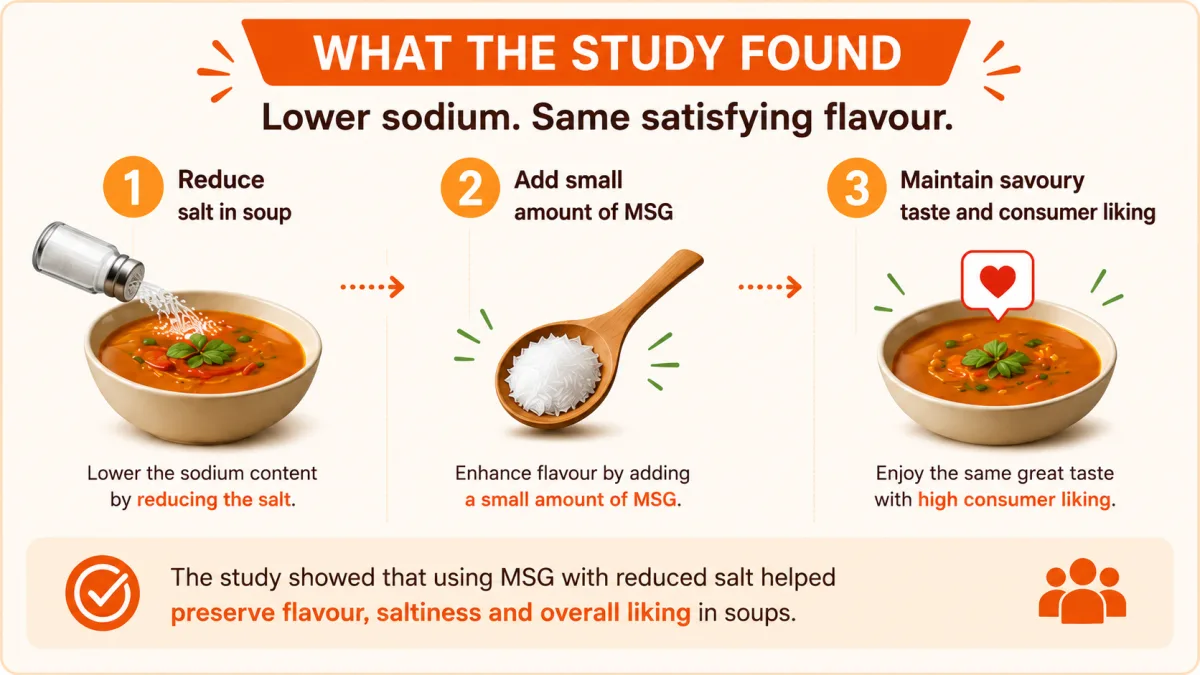
Cutting back on sodium often comes with a familiar trade-off: food starts tasting a little “flat.” That’s the challenge behind sodium reduction. How do we keep the same comfort and punch, without leaning so heavily on sodium? A study by Walker and Dando (2023) looked at exactly this in lower-salt soups. Their finding was simple but useful. When part of the salt was replaced with MSG, people still perceived the soup as flavourful and satisfyingly “salty,” even though the overall sodium level was lower. In other words, taste held up. And that matters, because flavour is often the first thing people notice, and the first thing they reject, when sodium drops too far.
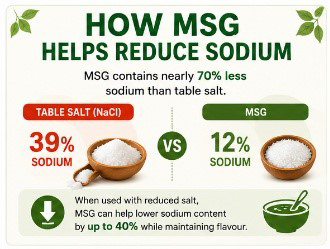
MSG helps here because it does not behave like regular salt. It has nearly 70% less sodium than table salt, but it boosts savoury flavour in a different way. Used in small amounts alongside reduced salt, MSG can cut sodium in certain foods by up to 40% while keeping the dish enjoyable. This is especially relevant for savoury foods, where depth and “umami” do a lot of the heavy lifting.
In the soup formulations tested in the study, researchers measured consumer responses across flavour, saltiness, and overall liking. Potassium chloride came up in the broader sodium-reduction conversation, but MSG stood out in a very practical role: it helped preserve the familiar savoury taste people expect from soups. And that is especially pivotal, as many lower-sodium products fail because the taste shift is too obvious.
What’s also interesting is how workable this approach is. Food scientists increasingly point to MSG-based sodium reduction as a change that doesn’t demand dramatic recipe overhauls. And in Indian cuisine, where spices and savoury bases already create complexity, MSG can fit in naturally by supporting flavour while helping bring sodium down in dishes like soups, curries, and even snacks.

All of this lands in a bigger public health context. Global health agencies continue to push for lower sodium intake because of its link to hypertension and cardiovascular disease. MSG-based sodium reduction is of course not the only tool in our arsenal, but it is one of the most practical one – for manufacturers, chefs, and home cooks who want food that still tastes like food.