
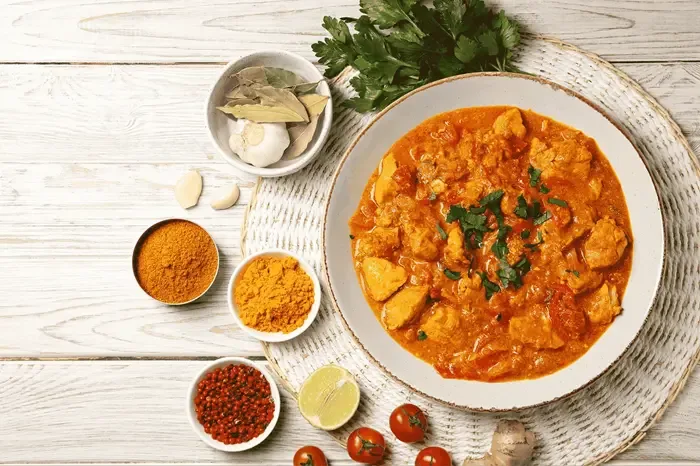
The Indian curry – the iconic dish recognized globally as a flavourful and delicious spiced accompaniment to all staple cereal preparations is deeply associated with Indian culture and cuisine. Why Indian? Spices are the soul of a curry and India is the home of spices. Curries probably originated from India, hence the name ‘Indian curry’, though we do find curries in other cultures too. While the nomenclature of ‘curry’ is debatable being attributed to Portuguese or British influence, origin of curry can be linked with growing of cereals and the diet patterns which necessitated spicy dishes to complement the bland cereals. Curries are traditional Indian dishes, part of everyday meal, in which vegetables, legumes or meat form the main ingredients. Curries are favored for their creamy texture, unique flavor and delicate aroma derived from spices.
Indian cooking derives itself from the therapeutic principles of ancient Ayurvedic medicine based on practical and spiritual concepts and uses abundant spices. Ayurveda categorizes food into six tastes or Rasas, (very similar to the basic tastes mentioned in modern Sensory Science). Different spices and foods contribute to each rasa by affecting our digestion, disposition and health. To maintain perfect balance and be well-nourished, all six rasa should be part of every meal. This explains the complex spice combinations and the resulting depth of flavour experienced with Indian food. Varied and diverse spice combinations are used for different dishes / meal patterns / regions / physiological states, and cultures.
Spices have a multi-functional role in curry with contribution of nutrients, flavor and health promoting ingredients. Nutritional contribution of spices is comparatively smaller in terms of absolute amount. However, they indirectly contribute to increased food intake by enhancing organoleptic appeal of foods due to their presence by providing irresistible flavor quality. Spices are also recognized for their physiological role [medicinal quality], many of which are proven experimentally. The flavour binding in curry is due to multiphase components which forms the microstructure of curry. This is achieved by use of emulsifiers such as oilseeds and nuts. With advances in food processing, there are many ready to eat curry preparations which are packaged and sold with long shelf life.
Curries are essential part of every meal. They are associated with a unique role of providing satiety, physiological to give a feeling of fullness, and psychological, to give satisfaction. The inherent ingredients contribute essential nutrients and bioactive components. Curries are principally known by their solid base ingredients, such as vegetable curry, legume curry, fish curry prepared in different styles, which also becomes a part of nomenclature. The solid ingredients in a curry can be vegetables, legumes, cheese, meat, fish, eggs, etc. Ground ingredients such as selected vegetables, legumes, fresh or dry spices and emulsifiers [oil, oilseeds, nuts, milk cream, yoghurt, etc.] form the liquid media in which the solid ingredients are suspended. The ingredients used in a curry define nature of the curry, provide colour, texture, flavour and nutrients. Very often curries are a blend of all basic tastes, salt, sugar, sour, chilly, bitter, and astringent and the taste quality is amplified by chosen ingredients. Given below is a list of seasonings and spices used for their flavour quality in curries.
Basic taste ingredients
Salt - Sea salt, black salt, mineral salt, etc.
Sweet - Jaggery, sugar, honey, palm sugar, natural fruit.
Bitter - Fenugreek, Asafoetida.
Sour – Tamarind, raw mango powder (dry), garcinia combogia, garcinia indica.
Astringent – Spices such as mustard, cumin, omum.
Pungent- Chilli, pepper, ginger, clove.
The microstructure of curry represents multiphase components which are important for flavour of curry. The water soluble aroma components bind with water whereas fat soluble aroma components are bound to fat portion. Proteins form emulsion with fat and trap the aroma. Fats, oils, yoghurt, oilseeds and nuts [coconut, cashewnut, almonds, ground nuts, poppy seeds, water melon seeds, musk melon seeds, etc.] used in curries provide the creamy uniform texture.
Spices have an overall flavour potentiating effect on different ingredients of curry which is enhanced by various pre-processing or processing treatments such as grinding, soaking, roasting, steaming, extracting, boiling, cooking and frying. Seasonings are generally prepared by suspending a mixture of whole or ground spices in heated oil, thus bringing out the maximum aroma. Spices are also known for their preserving quality of being anti- microbial, anti-bacterial and lowering pH (acidulants such as tamarind and garcinia combogia inhibit microbial growth).
Are there any health concerns with respect to curries? Eating a healthy version, there are none. Nevertheless, curries sourced from catering establishments or street vendors can have very high fat/energy content. They may use unhealthy fat [trans fat]. There is risk of over-consumption of meat. There could be spices overload and the salt content could be very high.
What can be done to make curries healthier?
Reducing fat/oils in curries –
Reducing fat consumption without compromising taste quality is a challenge for catering food industry. However, a deliberate attempt has to be done to use less fat/oil while preparing gravies.
Avoid trans fats instead use healthy oil or oil blends.
Low fat gravy mixes :- Natural emulsifiers can be used for making low fat gravy mixes with enhanced sensory appeal.
Use small quantity of a natural emulsifier such as cashew nut, melon seeds, poppy seeds, coconut, ground nut to prepare gravy. These retain the taste quality with lower fat content.
Reducing salt in curries
Use herbs, spices, and flavour enhancers to increase salt perception.
A lesser spice content would lower the salt required, specifically sour taste and pungency.
Use a flavour enhancer such as monosodium glutamate [MSG] to enhance savory taste [ it has 12% sodium compared to 39% of salt. And minute quantities enhance the flavour remarkably]. MSG has been proven to be very effective in reducing salt content of dishes while preserving the palatability, hence it is a good option to use MSG to improve the flavour of curry and reduce salt.
To summarize, curries are unique dishes, probably of Indian origin, very important for the nutritional and sensory contribution to a meal. These multi-ingredients formulations are prized for their flavour quality. With significant contribution towards nutrients, healthier version of curries can be classed as protective foods.